


White Haze
Salts rise out of concrete pavers as moisture evaporates, leaving a chalky white film.
- Cause
- Minerals carried up from the paver and base
- Our treatment
- Efflorescence cleaner and a thorough rinse before sealing

 Paver Sealing & Restoration · Palm Beach County
Driveways, patios, and pool decks lose their joint sand to Florida rain, storms, and pressure washing. We clean, treat, re-level, re-sand, and seal so your pavers look new and stay tight.

Faded, stained, weedy pavers brought back to their original color, with clean joints and a protective seal.
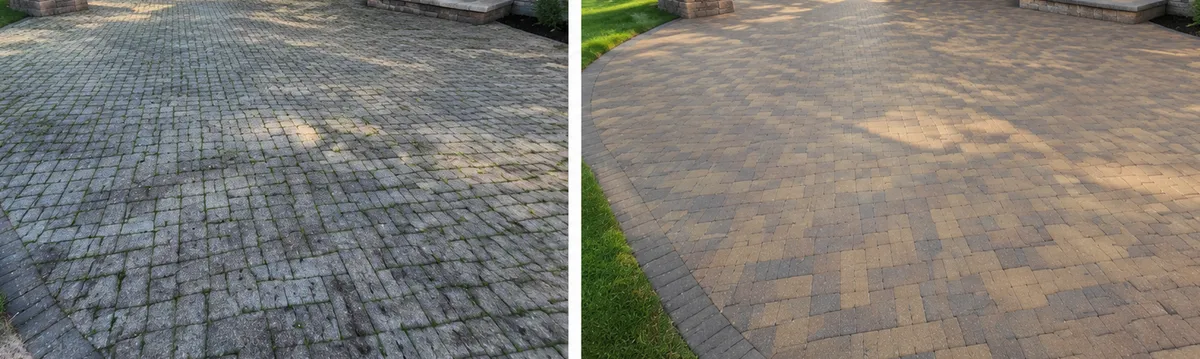
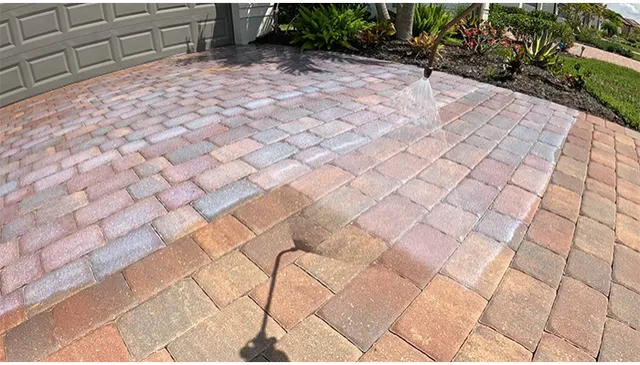
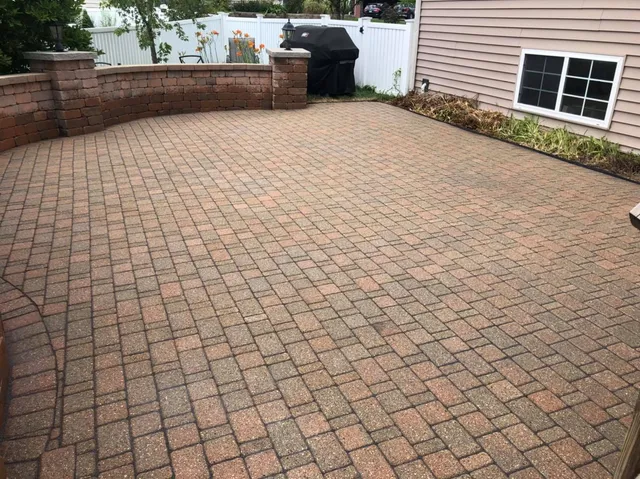
Original color, tight joints, lasting protection.

The sand between pavers is what holds them together. Each paver presses against its neighbors through those joints, so the surface acts as one interlocking slab. When the sand leaves, the lock goes with it.
Summer downpours and tropical storms flush loose sand out of the joints, especially on slopes and near downspouts.
A wand held close to the surface blasts sand from every joint it passes. Cleaning without re-sanding leaves pavers loose.
Sprinklers, gutters, and pool splash-out keep joints wet and slowly carry fine sand away.
Ordinary sand never hardens, so wind, water, and sweeping take a little more every month.
Turning tires and daily weight rock pavers and grind joint sand down into the base.
Fire ants dig out sand to build mounds, and roots push up through open joints.
What you see is only the top layer. A lasting restoration checks every part that holds it up.
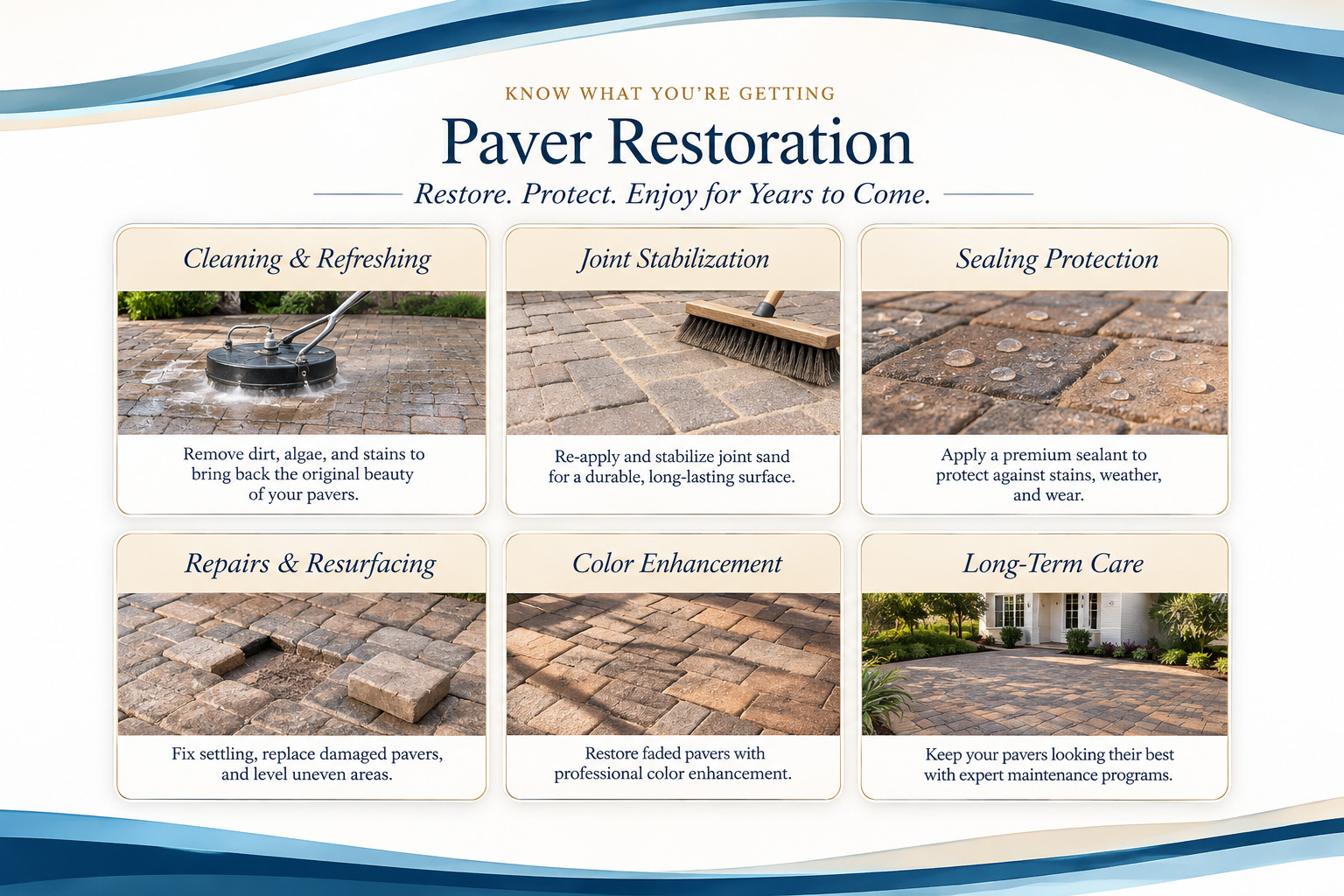
Cleaning, joint stabilization, sealing, repairs, color enhancement, and long-term care. Every stain has a different cause, and each needs its own treatment.
Salts rise out of concrete pavers as moisture evaporates, leaving a chalky white film.
Common in Florida, from well-water irrigation, fertilizer, and metal furniture.
Oil drips and hot-tire marks soak into the paver surface where cars park and turn.
Shade, humidity, and pool water feed growth that makes pavers dark and slippery.
Weeds root in empty joints, and ants pile excavated sand on the surface.
Dips where water pooled, and pavers raised by roots or settling base.
After deep cleaning, the joints are mostly empty. What goes back in decides how long the restoration lasts.
Polymeric sand only works when it’s installed right: pavers fully dry, joints filled to the proper depth, every grain swept off the surface, and a light, controlled mist to activate it. Leftover sand on top can cause haze, so we clean as we go.
Sealer protects against UV fading, stains, and growth, and helps hold joint sand in place. The look is up to you.
Deepens color and adds shine, like pavers just after rain. A favorite for driveways and entries.
Protects without changing the look much. Often chosen around pools where traction matters.
Brings faded tones back with a low sheen, between natural and wet look.
Sealer goes on only after the surface and joints are dry, in thin, even coats. Too much sealer, or sealing over moisture, causes cloudy white patches. Around pools we can add an anti-slip additive.
We map stains, open joints, weeds, ant activity, and sunken or lifted areas.
Debris cleared from joints, then pressure washing to lift grime and old sand.
Rust, efflorescence, oil, and growth each treated with the right cleaner.
Sunken or lifted pavers reset, with the base underneath repaired where needed.
Joints refilled, compacted, and locked for a tight, clean finish.
Your chosen sealer restores color and protects for the years ahead.
Sealed pavers usually need resealing every few years in the Florida sun. A quick rinse and spot re-sanding between sealings keeps the joints full.
Plain joint sand never hardens, so rain, sprinklers, and pressure washing carry it away. Polymeric sand firms up and resists washout.
Done carelessly, it can etch the surface and empty the joints. We use controlled cleaning, then re-sand every joint before sealing.
Yes. We lift the affected pavers, correct the bedding and base underneath, and reset them level with the surrounding surface.
That haze is usually efflorescence. We treat it with an efflorescence cleaner and rinse well before any sealer goes on.
Sealing protects color from UV fading, resists stains and growth, and helps hold joint sand in place, so most Florida pavers benefit.
Foot traffic usually returns within a day, and cars after a longer cure. We give you exact times for the products used on your job.
We restore driveways, patios, walkways, and pool decks across Palm Beach County. We’ll inspect every joint and put the plan in writing.
Or call (561) 677-8919
We clean, re-sand and seal paver driveways, patios and pool decks in every city, town and village in Palm Beach County.
More reading: what affects project pricing and the Placidity blog.

Painting and Renovations for Palm Beach County, under one calm process.











(561) 677-8919
222 Lakeview Ave Suite 800, West Palm Beach, FL 33401